- The Political Pulse
- Posts
- Political Science Updates and Highlights For Spring 2026
Political Science Updates and Highlights For Spring 2026

Lydia Miljan
April 15, 2026
Message from the Head
As always we end the semester with mixed feelings. The sense of accomplishment of finishing an academic year is tempered by the realization that many students will be graduating and leaving the University. We congratulate all those who have completed their degrees and wish you well in your pursuits of continuing your education in graduate school or the professions.
This summer marks the 16th year of the Europe Abroad course. There are still some spots open. This is an excellent opportunity to have a guided tour of important European institutions and get a credit for a 4th year course. This year the course is offered by Dr. Essex.
Erratum: the EU course is now full. Sorry for any confusion.
The department had a very successful academic year with students participating in conferences both in Windsor and at other institutions. We have a dynamic student body with several student groups active on campus.
Table of Contents
UWill Discover Presentations
Several students from the department’s Political Science, International Relations, and Law & Politics programs presented their work as part of the university’s UWill Discover undergraduate conference this March. Most of the students who presented are completing their undergraduate thesis projects and have been working diligently on independent research projects under the guidance of a faculty supervisor during the fall 2025 and winter 2026 semesters. And as in previous years, these students took home numerous awards for their research presentations after the conference.
“Our students have always performed well at the UWill Discover conference and this is a reflection of the work they've put into their research over the course of the academic year.”
Among Arts, Humanities, and Social Science students presenting at UWill Discover, Danika Scharff won a silver medal for her work on comparative responses to mass shootings in Canada and the US, while Raina Saffron and Sami Barakat won bronze for their papers on, respectively, political impacts of synthetic media and AI-generated images and shifting norms on international arms trade during the Cold War. Morgan Robinson won bronze as well for her poster presentation on the relationship between economic inequality and public trust in government in Canada since covid, and Sabrina Kelly won the Equity, Diversity, Inclusion, and Decolonization Award for her presentation on anti-trans legislation and discourse in the US. Also presenting at this year’s conference were Taibat Idris, Eric Joshi, Jada Malott, Katie Murray, Orchid Sayed, Femi Soluade, and Gina Touma.
“Our students have always performed well at the UWill Discover conference and this is a reflection of the work they've put into their research over the course of the academic year,” said Dr. Jamey Essex, who teaches the POLS-4970 Political Science Thesis 1 research design course in the fall. “They have developed their projects from scratch since September and make great use of this chance at the end of the winter semester to show how far they’ve come with it.” The department congratulates those students who won awards and all who took part in the conference.
Model NATO

The Model NATO conference 2026 was a student conference hosted by Carleton University. This fully immersive experience allows students to understand what NATO operations may look like and to prepare as delegates and present on behalf of a country. Student participation from the University of Windsor helped students build new networks and gain conference experience!
Centre for Pluralism and Democracy
If you have been looking for a space on campus where serious research meets the questions you are already thinking about, the Centre for Pluralism and Democracy is worth knowing about.
Located in the Faculty of Arts, Humanities, and Social Sciences, the CPD brings students into faculty-led research on some of the most pressing issues of our time. Democratic institutions are eroding. Economic inequality is widening. Tariff wars, mass deportations, and the concentration of power in the hands of a shrinking elite are no longer distant concerns. They are the headlines you are reading every morning.
The CPD takes these developments seriously as objects of research. The centre engages with scholarship that places Indigenous and decolonial perspectives at the centre of understanding how modern democracy has worked and where it has failed. Students can contribute to real research projects, attend talks, and be part of a community working to make sense of this moment with rigour and honesty.
More opportunities for student involvement, community engagement, and public outreach are also on the way. Getting involved now means being part of shaping what the CPD looks like as it grows.
Watch this space for upcoming events and ways to get involved.
National Security Conference
Aanustup Singh Rathore and RJ D’Aguilar recently represented the department at the Canadian Undergraduate Security Conference, held at the Royal Military College in St‑Jean, Quebec. Their original research was accepted through a competitive peer‑review process and were invited to participate as panelists alongside undergraduates from across the country, spanning British Columbia to Nova Scotia.
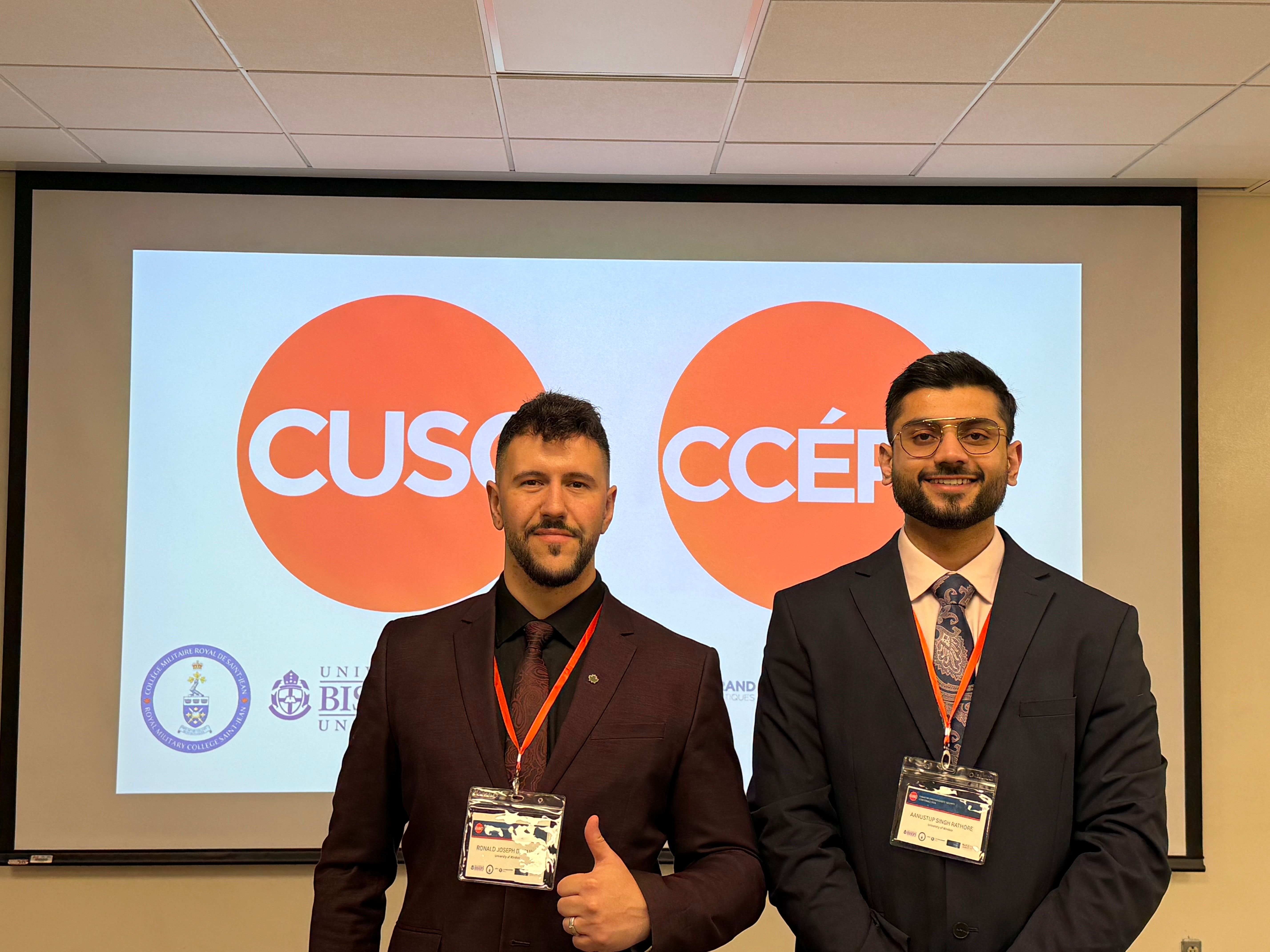
RJ D’Aguilar and Aanustup Siingh Rathore
The conference focused on contemporary Canadian and global security challenges, organized around three thematic areas: Maintaining Peace and Projecting Power; National Sovereignty and Global Governance; and Economic Security in a Multipolar World. Hosting the conference at the Royal Military College offered a distinctive academic environment, bringing together civilian and military perspectives through student presenters, faculty discussants, and invited dignitaries. This setting also provided valuable networking opportunities for participants interested in security studies, public policy, and defence issues.
Aanustup Singh Rathore paper, “Institutional Resilience and Wartime Adaptation: Cyber Defense Strategies in Estonia and Ukraine," examines two core questions from the CUSC call of proposals— which infrastructures are considered strategic and why, and how states build resilience against cyber risks. Using a comparative analysis of Estonia (peacetime model) and Ukraine (wartime model), the paper argues that cyber resilience is ultimately shaped by institutional capacity and governance structures rather than technology alone.
RJ D'Aguilar presented research on Canada’s Arctic and High North, exploring the region’s growing strategic importance. His work addressed commercial and transit opportunities, trade routes, Indigenous partnerships, and defence considerations in the context of climate change and shifting geopolitical dynamics.
Students accepted as conference panelists were supported through travel and accommodation subsidies administered by the Royal Military College in partnership with the Department of National Defence.
Both participants emphasized the conference as a meaningful academic, professional, and civic experience, and strongly encourage students with strong research skills and the ability to travel to consider applying in future years. The conference is expected to actively recruit undergraduate panelists from Canadian universities in the next academic cycle.
Alumni News
Congratulations to Logan Carmichael, who graduated from the Honours Political Science program in 2017 and has just successfully defended her PhD dissertation, “Cybersecurity Governance Responses in the Estonian Digital Governance Model, 2007–2023,” at the University of Tartu’s Johan Skytte Institute of Political Studies. Logan has also been working as a junior research fellow on e‑governance at the Institute.